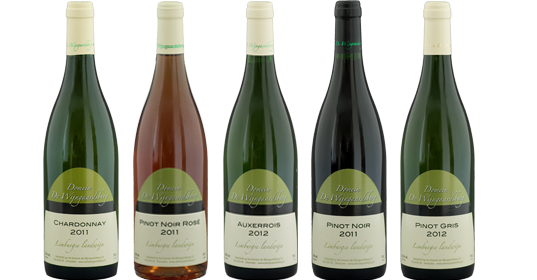
I recently had the pleasure to receive a bottle as a gift of Pinot Noir that was grown and produced in the Netherlands. Apparently they have a region in the southern part Holland where historically they have been growing grapes for centuries. Typically known as a very flat and also a majority of this country is under the sea level line making it a bit difficult to grow grapes. Well to find out that there is this area in the southern part of Holland called South Limburs you will find not only a very hilly area but this is the only part of the country that is above sea level at a total of 322 meters, the same as us here in Barolo and Barbaresco (there are some parts here that are higher but the medium is around 300 meters). The soil structure of this area they call Marl which is a blend of Loess (a loamy deposit formed by the winds,characteristics are yellow in color and very calcareous), and Limestone. Believing this soil structure is coming from the Pleistocene period being formed from glaciers rubbing together.
I was invited to a dinner party with a bunch of people who really know their stuff about wine, and well I thought then it would be a good time to pull out this surprise for the blind tasting. And I must say it was a surprise. First off they got that it was Pinot Noir, but for a Pinot we were having trouble telling if it was one that came from Oregon or as they had suspected Alto Adige. There defiantly was a fruitiness that we suspected was not typical of France or Germany.
At the end in my conclusion if you are ever in this area I recommend stoping by Domein De Wijngaardsberg to have a taste. They also work with Chardonnay and Pinot Gris. Very good and interesting wines.
www.dewijngaardsberg.nl
Monday, June 15, 2015
Saturday, June 13, 2015
The WORST of the BEST
A little something to think about....
There are hundreds of ways to talk about Barolo and one thing that I talk about quite a bit with my guests is the standard of Barolo. When you take the name BAROLO you are talking about the king of wines a wine that is quite commonly compared to Burgundy. Barolo is known for it's complexity, elegance, and ability to age for quite a long time and transform into something that could be depending on the person life changing.
With that said those of you who use the words "BASIC, BASE, NORMAl, or NORMALE (or what gets me the most is ENTRY LEVEL)" really need to cut it out. I don't know who decided to make this popular. Really how it sounds is you are taking the best thing ever and telling people that it's crap. Why do that? I mean even in the worst vintages of Burgundy they say "oh this was a classic vintage." I think we need to take some notes on marketing skills here, people.
A brief history of Barolo.
Before the 1970's when single vineyards were starting to be introduced, everyone made just one wine either it was Barolo or Barbaresco and how they made it was by blending together their vineyards. This today is called the classic or traditional recipe for Barolo, the art of blending to get the wine just right.
Wednesday, June 10, 2015
Fresh fruit jam Crostata
Being a really great year for Cherries and Strawberries we decided to buy them by the crate allowing us to make jam from both of them. It is a good way to preserve the freshness of the fruits because after about a day in the fridge you notice a lot of them are going bad.
So we started off with the jam first made one batch of Cherry and one of Strawberry. For these I recommend to use pectin to reach a consistency perfect without having to use too much sugar.
For the fresh berry jam:
2 Lbs of fruit
2 cups of sugar
1 packet of pectin
I recommend for this to place the sugar and pectin on top of the cold fruit, mix it together and then turn on the burner. Get the fruit to a boil quickly let simmer for about 3 minutes and then you are done. This is something that needs to be done quickly so you keep the chunks of fruit and also the color.
For the Crostata:
This recipe I have adapted from the Mozza cookbook, Thank you Nancy and Dahlia these recipes are great!
For the crust:
2 teaspoons of white sesame seeds
1 1/2 cup all purpose four
3/4 cup powdered sugar
1/2 cup butter room temp cut into cubes
1/4 teaspoon Pane Angel or 1/8 tsp baking soda 1/8 tsp baking powder
Pinch of salt
4 fresh egg yolks
Toast the sesame seeds for about a minute or so until the color starts to brown. Set them aside to cool.
Using a food processor, combine the flour, powdered sugar, butter, leavening, and salt. Pulse until it resembles a corse cornmeal consistency, about 2 minutes. Then add the egg yolks and mix until the dough is smooth around 2 to 3 minutes. Dust a flat work surface with flour and turn the dough out onto it. You will notice the consistency of the dough is a bit wet and sticky that is good. Kneed the dough for a few minutes until it comes together into a ball. Wrap it in plastic and set it in the fridge for about and hour.
Remove the outer wall of a spring pan and line the bottom with parchment paper. Remove the dough from the refrigerator, dust a flat work surface with flour, and kneed the dough until it is the texture of Play - Doh. Dust your work surface again and roll out your dough until it is about a 1/4 inch thick. Place the dough on top of your prepared dish and cut around the edge of the pan remembering that the sides will be put back on later you will want to cut either right on the line or a bit inside. From the scraps of the dough you will use to decorate the crostata.
Roll the edges of each dough round toward the center to create a rim about 1/8 inch thick. If the jam has cooled to the point where it is too thick to spread, warm it over low hear just to loosen it. Spoon in the center and spread it evenly with an off set spatula. Once the whole crostata is filled with the jam you can start to roll out long tubes to decorate. After the decoration place back the rim of the spring pan to ensure that the crostata stays intact while baking.
Preheat the oven to 350 F 180 C and bake for 20 to 25 minutes. Once the dough has become golden brown remove from the oven and let cool before removing the sides.
Enjoy!
Subscribe to:
Posts (Atom)


