Wednesday, July 22, 2015

De Pata Negra


Pata Negra (black hoof), Jambón Ibérico, Jambón Ibérico de bellota not to be confused with the Jambón Serrano coming from the white pig in the eastern part of Spain.  The Jambón Ibérico is coming from the Ibérico breed of pigs known for its flavorful fat. And my is it wonderful. What makes this ham so special is what they eat.  Like anything really when it is feed good, but in particular the acorns that are a must in their diet make them taste so good.  The acorns have the same oleic acid that is found in olives.  This tastes makes its way into the fat of the animal giving it it's flavors and also it's delicacy, and as the Spaniards will say "olives with legs".  Resulting in a very creamy delicate fat.  Also the pigs themselves are known for their large bellies and little skinny legs.  See photo below...


On our recent trip to one of the Canary Islands (Tenerife) we had a really great recommendation to visit this lovely aperitif hot spot Depatanegra who also conveniently has a little specialty shop right next door for your at home consumption.  My taste buds have never felt so good, from the wonderful staff who were friendly and also knowledgeable and not to mention  patient (my italospanish is not so good) we ended up tasting the more interesting wines of the island a big surprise for my Nebbiolo taste buds and tasting our way through an over generous plate of Pata Negra!


We got to taste from the North West Salamanca and to the South West we tasted from the Huelva and Córdoba and then there was the Extremadura.  Each one was excellent in it's own way but for me the favorite was the Córdoba having such a rich nutty fruity taste in comparison to the others. 

If you are ever in Tenerife you must check them out.  


Monday, June 29, 2015

Not all the Flavors are Mint


So today in the newspaper in Italy there was this super article about the reasons why the Italian men are the best in the world.
And this is the top 10 reasons why...

1. They know how to cook and they are good at it

2. If by chance they don't cook for you one night you can rest assure that they will buy you a very nice dinner.

3. They know how to entertain you. They have many hidden talents that when they need to can make you laugh at any second.  Like all of a sudden you are dancing salsa in the streets.

4. They know how to be sexy especially when they are on the hunt.  And they have a hard time accepting a NO so they will try everything to get a YES. (revert back to number 3)

5. They think they can do everything....

6. They are very creative with both positive and negative.  In any case they are able to find an excuse to get out of anything.

7. They Italian men you don't have to worry about them getting a beer belly because they all prefer to dink wine.  Which is said with one glass a day is supposed to help reduce belly fat.

8. They love to dress with style and elegance, and they don't leave that just to a wedding or a special occasion.

9. They love to drive fast.  (it is not always a good thing)

10. Their creativity does not stop in the bedroom.

Sunday, June 28, 2015

Moccagatta Barbaresco

Every time I get the chance to visit another winery I am always so impressed.  I love to have the opportunity to see what the producers are doing taste the most current vintages and many times learn some new things.
It was a very wonderful visit we had with Martina Minuto. She welcomed us and gladly showed us around her winery.  She told us the history of the family, and how her father and uncle were the pioneers who made Moccagatta what it is today.  Typically the name of a family owned winery here in Piemonte is taken from the family name, however in this case Moccagatta being owned and operated by the Minuto family did not necessarily follow in that direction.  The once was farm house that has been wonderfully transformed into a fully functioning winery has been built on the Muncagöta vineyard.  Sound familiar?  Well their name was taken from the Piemontese name of this vineyard.
The wines we tasted were the Chardonnay "Buschet"
(coming from the word Boschetto) meaning little forest. I like tasting Chardonnay from Piemonte, it shows very differently than Chardonnay from France or the new worlds.  Chardonnay here has a nice history, it is in no way new to this area.  As a matter of fact the Marchesa di Cavour who was known to have such a love for Burgundy decided to not only have a french oncologist come to this area but with him she had requested he bring some clippings of Pinot Noir and Chardonnay.  So for all of you who were wondering it was because of her that we today will be able to find these grapes.
The two single vineyard Barbaresco that we had tasted were from the sites of Bric Balin and Barsarin.  Bric Balin is a special selection with in their Muncagöta vineyard which surrounds their estate.  Known for its clay and limestone rich soils makes a very muscular example of Nebbiolo coming from Barbaresco.  This wine had much more power fruit, structure with respect to the other vineyards we had tasted. The vintage 2012 is turning out to be a good structured very aromatic vintage loads of fresh red fruits and flowers.
Barsarin is located in Neive right on the boarder of Barbaresco where the soils are much richer in sand and limestone.  Here the sand helps to make the wine much more elegant, aromatic, and fresh.  This wine for me was much more approachable now the tannins were much more softer and it showed much more red fruits.  Both 2012's were wonderful and this experience was amazing.

Monday, June 15, 2015

Wine from where?!! The Netherlands you say...


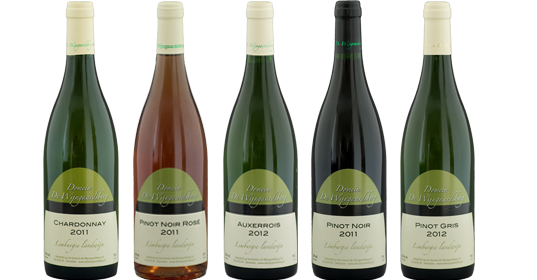
I recently had the pleasure to receive a bottle as a gift of Pinot Noir that was grown and produced in the Netherlands.  Apparently they have a region in the southern part Holland where historically they have been growing grapes for centuries. Typically known as a very flat and also a majority of this country is under the sea level line making it a bit difficult to grow grapes.  Well to find out that there is this area in the southern part of Holland called South Limburs you will find not only a very hilly area but this is the only part of the country that is above sea level at a total of 322 meters, the same as us here in Barolo and Barbaresco (there are some parts here that are higher but the medium is around 300 meters).  The soil structure of this area they call Marl which is a blend of Loess (a loamy deposit  formed by the winds,characteristics are yellow in color and very calcareous), and Limestone.  Believing this soil structure is coming from the Pleistocene period being formed from glaciers rubbing together.

I was invited to a dinner party with a bunch of people who really know their stuff about wine, and well I thought then it would be a good time to pull out this surprise for the blind tasting.  And I must say it was a surprise.  First off they got that it was Pinot Noir, but for a Pinot we were having trouble telling if it was one that came from Oregon or as they had suspected Alto Adige.  There defiantly was a fruitiness that we suspected was not typical of France or Germany.

At the end in my conclusion if you are ever in this area I recommend stoping by Domein De Wijngaardsberg to have a taste.  They also work with Chardonnay and Pinot Gris.  Very good and interesting wines.
www.dewijngaardsberg.nl 

Saturday, June 13, 2015

The WORST of the BEST

A little something to think about....

There are hundreds of ways to talk about Barolo and one thing that I talk about quite a bit with my guests is the standard of Barolo.  When you take the name BAROLO you are talking about the king of wines a wine that is quite commonly compared to Burgundy.  Barolo is known for it's complexity, elegance, and ability to age for quite a long time and transform into something that could be depending on the person life changing.
With that said those of you who use the words "BASIC, BASE, NORMAl, or NORMALE (or what gets me the most is ENTRY LEVEL)" really need to cut it out.  I don't know who decided to make this popular.  Really how it sounds is you are taking the best thing ever and telling people that it's crap.  Why do that?  I mean even in the worst vintages of Burgundy they say "oh this was a classic vintage."  I think we need to take some notes on marketing skills here, people.
A brief history of Barolo.
Before the 1970's when single vineyards were starting to be introduced, everyone made just one wine either it was Barolo or Barbaresco and how they made it was by blending together their vineyards.  This today is called the classic or traditional recipe for Barolo, the art of blending to get the wine just right.

Wednesday, June 10, 2015

Fresh fruit jam Crostata


Being a really great year for Cherries and Strawberries we decided to buy them by the crate allowing us to make jam from both of them.  It is a good way to preserve the freshness of the fruits because after about a day in the fridge you notice a lot of them are going bad.
So we started off with the jam first made one batch of Cherry and one of Strawberry.  For these I recommend to use pectin to reach a consistency perfect without having to use too much sugar.

For the fresh berry jam:
2 Lbs of fruit
2 cups of sugar
1 packet of pectin
I recommend for this to place the sugar and pectin on top of the cold fruit, mix it together and then turn on the burner.  Get the fruit to a boil quickly let simmer for about 3 minutes and then you are done.  This is something that needs to be done quickly so you keep the chunks of fruit and also the color.

For the Crostata:
This recipe I have adapted from the Mozza cookbook, Thank you Nancy and Dahlia these recipes are great!

For the crust:
2 teaspoons of white sesame seeds
1 1/2 cup all purpose four
3/4 cup powdered sugar
1/2 cup butter room temp cut into cubes
1/4 teaspoon Pane Angel or 1/8 tsp baking soda 1/8 tsp baking powder
Pinch of salt
4 fresh egg yolks

Toast the sesame seeds for about a minute or so until the color starts to brown.  Set them aside to cool.
Using a food processor,  combine the flour, powdered sugar, butter, leavening, and salt.  Pulse until it resembles a corse cornmeal consistency, about 2 minutes.  Then add the egg yolks and mix until the dough is smooth around 2 to 3 minutes.  Dust a flat work surface with flour and turn the dough out onto it.  You will notice the consistency of the dough is a bit wet and sticky that is good.  Kneed the dough for a few minutes until it comes together into a ball.  Wrap it in plastic and set it in the fridge for about and hour.
Remove the outer wall of a spring pan and line the bottom with parchment paper.  Remove the dough from the refrigerator, dust a flat work surface with flour, and  kneed the dough until it is the texture of Play - Doh.  Dust your work surface again and roll out your dough until it is about a 1/4 inch thick.  Place the dough on top of your prepared dish and cut around the edge of the pan remembering that the sides will be put back on later you will want to cut either right on the line or a bit inside.  From the scraps of the dough you will use to decorate the crostata.
Roll the edges of each dough round toward the center to create a rim about 1/8 inch thick. If the jam has cooled to the point where it is too thick to spread, warm it over low hear just to loosen it.  Spoon in the center and spread it evenly with an off set spatula.  Once the whole crostata is filled with the jam you can start to roll out long tubes to decorate.  After the decoration place back the rim of the spring pan to ensure that the crostata stays intact while baking.
Preheat the oven to 350 F 180 C and bake for 20 to 25 minutes.  Once the dough has become golden brown remove from the oven and let cool before removing the sides.
Enjoy!

Monday, June 8, 2015

A new Adventure


So I have been living in Italy now for almost 4 years. I've got a few harvest under my belt and have eaten and drank my way almost all over the entire country. I have not been however to the food capital Bologna but that is only because of my fear of explosion. With that said and my desire to always want to do more has found me starting up my own business where I can share with all of you my better experiences that I have had during my time here in Piedmont. What that is, is coming with me on a one day or more depending on how much time you have, journey to visit some of the most beautiful areas in Piedmont, visiting some wineries, having a lunch at the best restaurant, and seeing some of the more beautiful vistas and towns that you might miss if it was not insisted. What I am talking about Tour Piedmont LLC. Visit my site www.piedmontwinetour.com Share it with your friends and loved ones who are planning a trip here. I've got the insider scoop of best local places and some know how that can make travels a bit easier.

Sunday, March 23, 2014


Ramen!
Adapted from Bon Appetite and a collection of other online sources.


Realizing that we are in Italy and our ingredients we have available are a bit limited.   We had to be a bit creative and had to in some cases make the ingredients ourselves.  Which in turn was much fun and also we now have a better understanding for the ingredients them selves.


We are going to make this is three different parts:
First will be the stock
Ingredients:
1lb Chicken wings, back, or neck
½ lb pork spareribs
2 bunches of scallions, coarsely chopped
2 carrots, peeled, cut into pieces
1 head of garlic split, don’t peel of the skins
1 piece of dried kombu or another type of seaweed.
1 ½ lb pork loin
olive oil
sea salt and pepper

Tare:
¼ cup reduced-sodium soy sauce
1Tbs. dry white wine ex. Vermentino
½ Tbs. white vermouth

For the Tare combine all ingredients together set aside.

One day ahead: Season pork loin with salt and pepper.  Roll up and tie with kitchen twine at 2” intervals.  (this will help to keep the meat intact while cooking)
Heat oil in a large heavy pot (preferably the one you will make the broth in) over medium high heat cook pork loin, turning, until brown all over, about 10-12 minutes.  Add the chicken, spareribs, scallions, carrots, garlic, and seaweed.   Fill the pot with water then add the Tare.  Bring to a boil, reduce heat, and simmer, skimming the surface occasionally and add more water as liquid reduces, until pork shoulder is tender and stock has reduced to about 2 quarts, about 3 – 4 hours.
Remove pork shoulder from stock and let cool.  Wrap tightly in plastic and chill until ready to use.  (Chilling pork will make meat easier to slice.)  Strain the stock through a fine-mesh sieve into another large pot or a large bowl.  Discard the solids (including ribs and chicken).  Cover and chill.

Part two:
Ramen Noodles
I love living with an Italian because no one knows pasta like the Italians.  And well today we brought back an ancient pasta making tradition for these noodles.  Rolled and cut by hand, nothing could be more rewarding and more beautiful than hand made pasta.


For the dough:
1 ½ cup all purpose flour
2 eggs
salt
water if needed

on the kitchen table or a wooden surface place the flour in the shape of a volcano.  In the middle add the eggs and some salt.  Then with your fingers mix up the eggs into the flour until a dough forms.  If need be add some water to make sure the dough has a nice smooth texture.
Let rest for about 20 minutes.
Then on a clean work surface flour the surface then stretch the dough working with a rolling pin until it is about 1/8 inch thick.  Covering both side of the dough with additional flour so it does not stick when you have to cut it.
Once you have reached the thickness you desire roll up the dough on the rolling pin then remove the rolling pin from the center leaving the dough in its rolled form.
Take the knife and cut from the edge 2 mm thick noodles.  Then toss them in some flour so they don’t stick together.


Part three where everything comes together:

Garnishes
2 fresh eggs
3 scallions, thinly sliced

Soft boil your eggs for about 7 minutes then immediately place in a bowl of ice water to stop the cooking process.
Heat up about 4 cups of the broth.  From this you will add the scallions and also the pork to heat up.  Bring to a boil then add your noodles and let cook for about 4 minutes.
Then you are ready to plate, as you like.  I placed the noodles in a bowl first then placed the pork on top of the bed of noodles, then added the broth.
Enjoy!